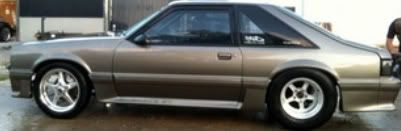
Im not a big gt fan either and I think it looks killer. Makes me wanna mini tub my car


 The Powdercoating guy

Im not a big gt fan either and I think it looks killer. Makes me wanna mini tub my car
 LS1 Swap
That thing would look better under a tarp in the back yard. I will compliment you at a later date, just not feeling it today.
xtremeoutlawseries.comOriginally Posted by 89notch

 SBZ HAD T-SHIRTS??? WTF
Killer looking car and an awesome build!
The Bad Boy!
 wheels up
car looks awesome Greg
 The Human Calculator
The car looks absolutely freakin' killer Greg!!
Peace
James
1990 ssp black coupe (aka ROCKET), bone stock CI unported E7's plus full mac exhaust, water pump and crank pullies, synthetic fluids, 14 degrees of timing, 80 mm maf, power pipe, 65 mm throttle body, 4.10 gear, welds and skinnies plus suspension. Best et to date 12.41, best mph to date 106.58 with a best 60ft of 1.59 on 26/8.5/15 Mickey Thompson slicks on a 64 degree day with 35% humidity all with 260rwhp and 320rwtq
 Jack Stand Racing League
Thanks for the compliments. Should have some more progress pics up in a few weeks.
Greg
Midnight Mafia
 Stang Hoarder
Looks great Greg, I saw it at Jason's and it was looking better each time I saw it. He got it straightened out and looking killer. Any updates lately?
Jack Stand Racing League
Thanks Mike, no big updates right now, had to make some room in the garage first. Should have some real updates in 3-4 weeks.
Greg
Midnight Mafia
 Registered User
I got a 90gt and was thinking about mini tub about how much did it cost anyways the car looks awsome
 slow ride..
Bad lookin mofo right there!
Jack Stand Racing League
Thanks, really appreciate it.
Greg
Midnight Mafia
 Registered User
that looks badass!
when a stroker windsor just wont do
Jack Stand Racing League
Well, got the holidays out of the way and my garage back in order so I'm finally getting some work done again. Going to start this phase by getting the brakes done and then who knows from there.
A few of the pieces I have going in:
Racecraft manual conversion
Skinny Kid brake line kit
Maximum Motorsports manual brake pedal kit
Ran into a potential problem when putting the master cylinder in. I bought the Racecraft kit because they make the smallest adapter that I know of and the master cylinder sits REAL close to the header. Need to figure out something about it, I'm not liking how close it is. I have a different master cylinder that gives me almost 1/2" more clearance but I really want to use the Strange master. Even with the 1/2" more clearance it's still too close IMO. Nothing is ever easy with these things.


Greg
Midnight Mafia
LS1 Swap
That will self clearance.
xtremeoutlawseries.com
Jack Stand Racing League
Figure I'll throw up a few before and afters of the rear hatch area etc.:
BEFORE
AFTER
BEFORE
AFTER
BEFORE
AFTER

Greg
Midnight Mafia
Jack Stand Racing League
Uh huh.
Anyone know the boiling point of brake fluid?
Greg
Midnight Mafia
Jack Stand Racing League
A few of my rear coil relocation kit finished:

Greg
Midnight Mafia
The Human Calculator
Looks wicked Greg!, as you already know that's some top notch quality work you've just posted up!
Peace
James
1990 ssp black coupe (aka ROCKET), bone stock CI unported E7's plus full mac exhaust, water pump and crank pullies, synthetic fluids, 14 degrees of timing, 80 mm maf, power pipe, 65 mm throttle body, 4.10 gear, welds and skinnies plus suspension. Best et to date 12.41, best mph to date 106.58 with a best 60ft of 1.59 on 26/8.5/15 Mickey Thompson slicks on a 64 degree day with 35% humidity all with 260rwhp and 320rwtq
LS1 Swap
So is that gonna make it out in 2012 Greg?
xtremeoutlawseries.com
Registered User
Brake fluid is subjected to very high temperatures, especially in the wheel cylinders of drum brakes and disk brake calipers. It must have a high boiling point to avoid vaporizing in the lines. This vaporization is a problem because vapor is compressible and negates hydraulic fluid transfer of braking force.
Quality standards refer to a brake fluid's "dry" and "wet" boiling points. Wet boiling point, which is usually much lower (although above most normal service temperatures), refers to the fluid's boiling point after absorbing a certain amount of moisture. This is several (single digit) percent, varying from formulation to formulation. Glycol-ether/dot three/dot four/dot five point one brake fluids are hygroscopic (water absorbing), which means they absorb moisture from the atmosphere under normal humidity levels. Non-hygroscopic fluids (e.g. silicone/DOT 5-based formulations), are hydrophobic, and can maintain an acceptable boiling point over the fluid's service life, although at the cost of potential phase separation/water pooling and freezing/boiling in the system over time - the main reason single phase hygroscopic fluids are used.
Boiling points for common braking fluids [1]
..........Dry boiling point ... Wet boiling point
DOT 3 .. 205 °C (401 °F) ... 140 °C (284 °F)
DOT 4 .. 230 °C (446 °F) ... 155 °C (311 °F)
DOT 5 .. 260 °C (500 °F) ... 180 °C (356 °F)
DOT 5.1 .. 270 °C (518 °F) ... 190 °C (374 °F)
There are currently 3 users browsing this thread. (0 members and 3 guests)
 Posting Permissions

 Reply With Quote